
Dance of the Reddish Egret in B&W
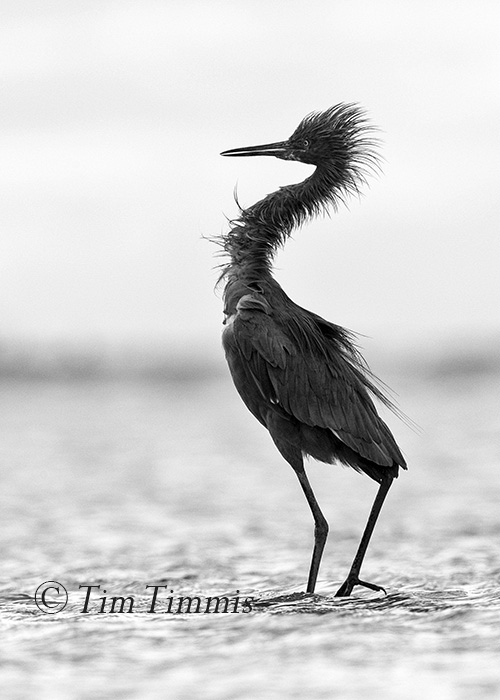
Partial sun turned into a cloudy morning at Bolivar Flats along the Gulf of Mexico. The colors were somewhat muted so I converted these into B&W to bring out the feather detail.
Watching Reddish Egrets dance around while fishing is always a good time and provides some great photo opportunities. This egret was very energetic and would launch himself out of the water to look for unsuspecting fish as the tide was slowly receding. In the last shot, he got all puffed up while chasing a white morph reddish egret away.
Taken with Canon 1DX and Canon 500mm F4 IS II with 1.4X III teleconverter mounted on Skimmer ground pod with Wimberley II gimbal head.
Aperture priority, 1/2500 sec @ F9, ISO 1600, evaluative metering, +1 exposure compensation, 700mm
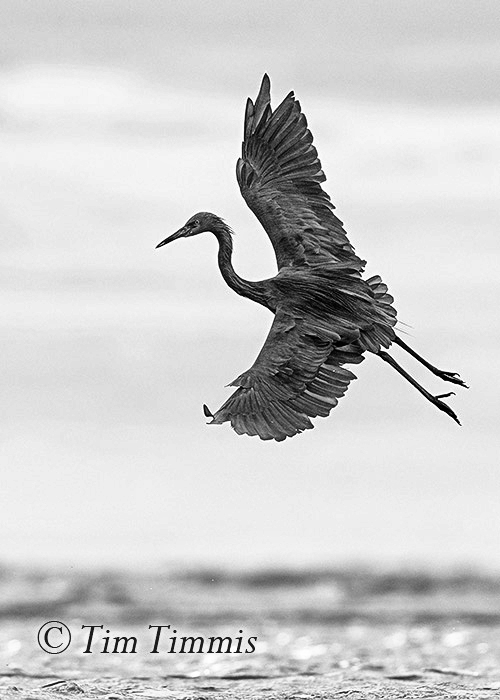
Aperture priority, 1/2500 sec @ F9, ISO 1600, evaluative metering, +1 exposure compensation, 700mm
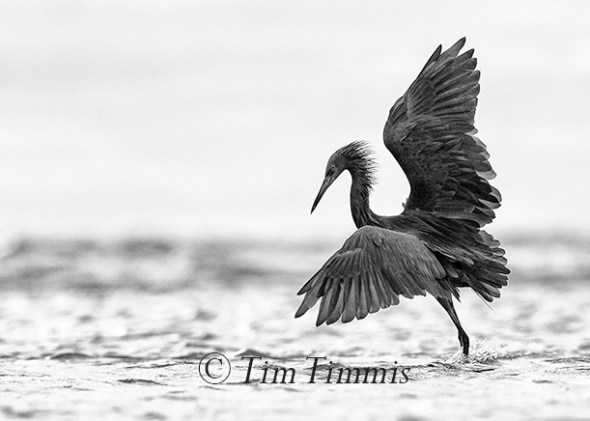
Aperture priority, 1/1250 sec @ F9, ISO 800, evaluative metering, +1 exposure compensation, 700mm
White Morph Reddish Egret
Found two White Morph Reddish Egrets at Bolivar Flats last weekend while guiding my old buddy Newton. He brought along Ruth Hoyt, who is an excellent professional photographer/guide at south Texas ranches, like Laguna Seca, where I first met her. It was great to see both of them again.
The tide wasn’t low but the birds were out in force. We started with a group of Willets and other small shorebirds with a lone Avocet nearby. There was a group of Avocets within striking distance but they were spooked and took off.
Spotted a couple of Reddish Egrets further down the shoreline and headed that direction. The Reddish Egrets weren’t very active initially so Newton and I headed back up the shoreline to a group of Black Skimmers.
We then spotted at least two White Morph Reddish Egrets back down the shoreline so we headed back in that direction. Lots of up and down on this trip. Found two White Morph’s and two Reddish Egrets along with one Great Egret standing around. They eventually started to catch fish with one of the Reddish Egret’s trying to chase the two white morph’s away.
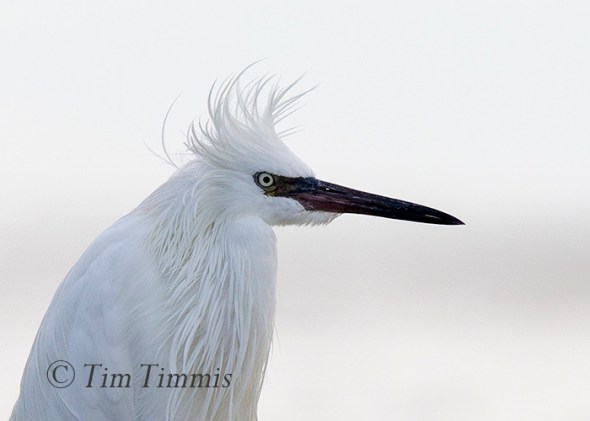
This White Morph was striking some nice poses with his feathers all perked up as he was checking out the other egrets.
Taken with Canon 1DX and Canon 500mm F4 IS II with 1.4X III teleconverter mounted on Skimmer ground pod with Wimberley II gimbal head
Aperture priority, 1/1600 sec @ F9, ISO 800, evaluative metering, +1 exposure compensation, 700mm
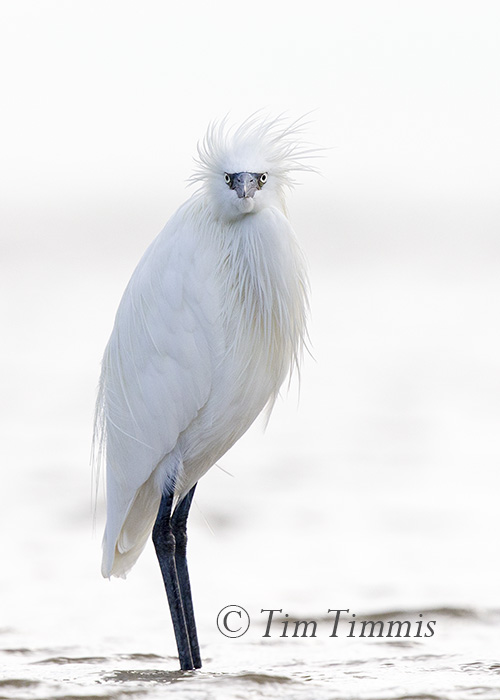
Aperture priority, 1/1600 sec @ F9, ISO 800, evaluative metering, +1 exposure compensation, 700mm
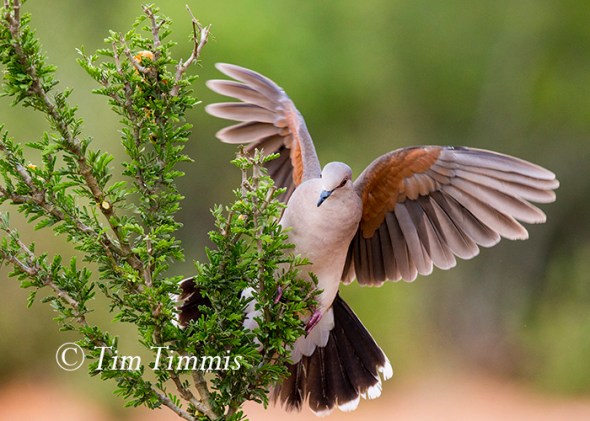
White Tipped Dove
White tipped doves don’t really show how colorful they really are until they extend their wings. Very beautiful birds.
Taken with Canon 1DX and Canon 500mm F4 IS II mounted on tripod with Wimberley II gimbal head
Aperture priority, 1/1250 sec @ F 6.3, ISO 1600, spot metering, 500mm
Aperture priority, 1/1000 sec @ F 6.3, ISO 1600, spot metering, 500mm

Owl Tender Landing
This Burrowing Owl tried to land in this thorny bush but didn’t stick around long. Kept his wings flapping for some good photo op’s. I’m gonna miss these little owls.
Taken with Canon 1DX and Canon 500mm F4 IS II with 1.4X III teleconverter, handheld out my car window.
Aperture priority, 1/500 sec @ F 5.6, ISO 3200, evaluative metering, +2/3 exposure compensation, 700mm

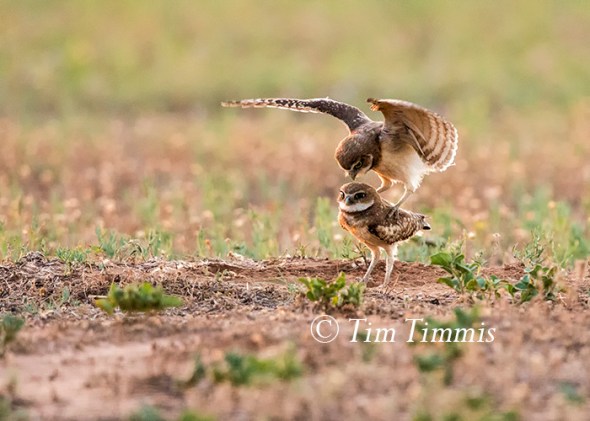
Guess Who?
This juvenile Burrowing Owl seems unphased by his sibling jumping on her back. Got several shots of the encounter with him reaching around and looking like he was trying to kiss her and then they fell over.
Taken with Canon 1DX and Canon 500mm F4 IS II with 1.4X III teleconverter, handheld out my car window
Aperture priority, 1/500 sec @ F5.6, ISO 6400, evaluative metering, +2/3 exposure compensation, 700mm
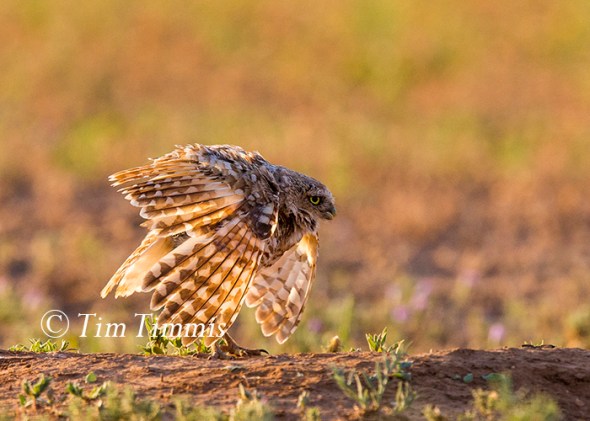
Intimidation
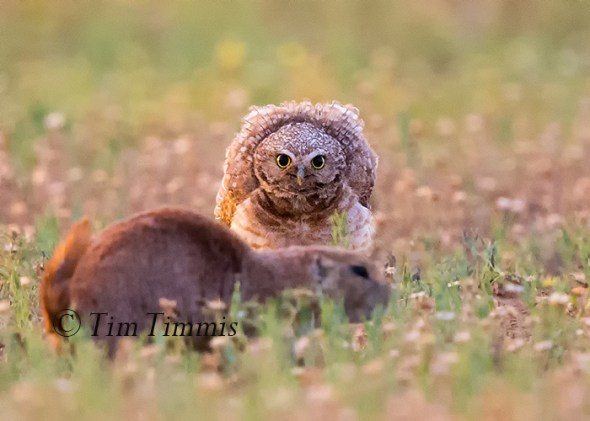
Here are more photos of Burrowing Owls trying to intimidate prairie dogs that got too close. They do a great job of expanding their body size with their feathers, which makes for some cool photo op’s. Hoping to get the opportunity to see them again.
Taken with Canon 1DX and Canon 500mm F4 IS II lens with 1.4X III teleconverter, handheld out my car window
Aperture priority, 1/1000 sec @ F8, ISO 1600, evaluative metering, 700mm
Aperture priority, 1/1600 sec @ F7.1, ISO 1600, evaluative metering, 700mm

Burrowing Owl’s Crazy Eyes
This would have been a good post for Halloween with the fully dilated eyes of this Burrowing Owl. He got all puffed up and stared down this prairie dog that got a little too close.
Saw this behavior a few times this summer but this was the only one with the owl looking in my direction.
Taken with Canon 1DX and Canon 500mm F4 IS II with 1.4X III teleconverter, handheld out the car window
Drinking Roadrunner
The roadrunners were the highlight of my last trip to Santa Clara Ranch in south Texas in June. On the last day, they were very cooperative and came to the pond to drink. Up close, they are very beautiful birds.
On the last photo, you can see the reflection of the pond in the water drop. They scoup up the water in their bill and tilt their head back to drink.
Taken with Canon 1DX and Canon 500mm F4 IS II mounted on tripod with Wimberley II gimbal head in a photo blind
Aperture priority, 1/2000 sec @ F9, ISO 3200, evaluative metering, 500mm
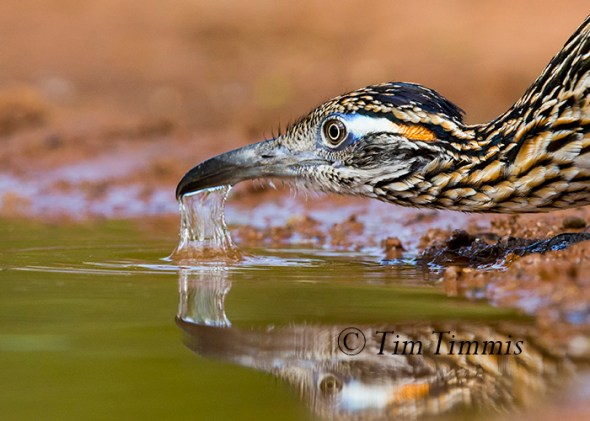
Aperture priority, 1/2500 sec @ F9, ISO 3200, evaluative metering, 500mm
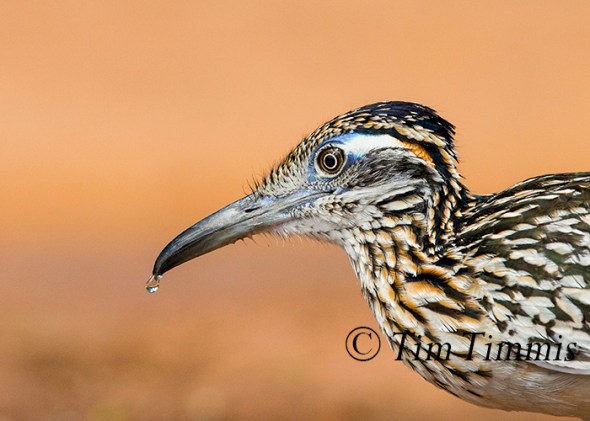
Aperture priority, 1/1600 sec @ F9, ISO 800, evaluative metering, 500mm
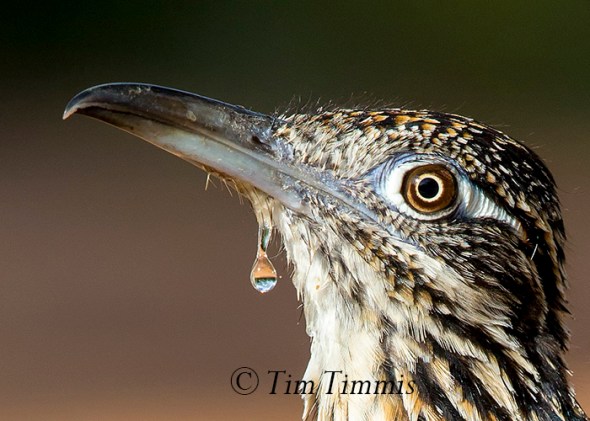
Bronzed Cowbird
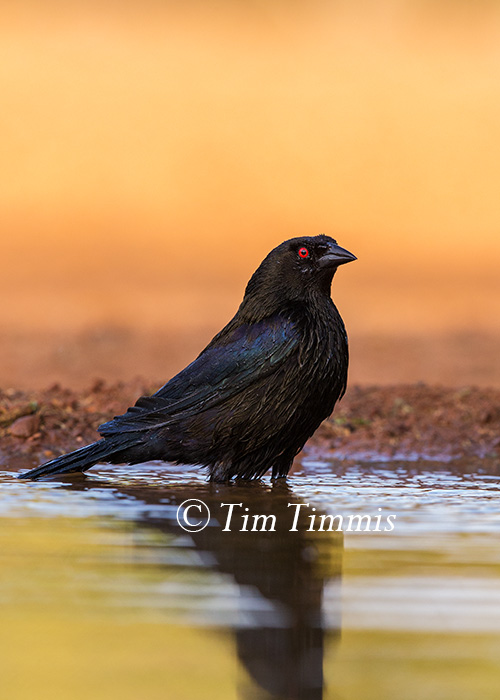
One of my favorite birds from my last trip to Santa Clara Ranch was the Bronzed Cowbird. They have a bronzed iridescence and their eyes turn red during breeding season. When trying to impress a potential mate, the male will vibrate his wings and hover in the air a few feet off of the ground. Got lucky on the last day and caught that behavior with the last two photos.
Taken with Canon 1DX and Canon 500mm F4 IS II on Wimberley II gimbal head mounted on a tripod
Aperture priority, 1/640 sec @ F8, ISO 1600, evaluative metering, 500mm
Aperture priority, 1/800 sec @ F8, ISO 1600, evaluative metering, 500mm

Aperture priority, 1/640 sec @ F5.6, ISO 1600, evaluative metering, 500mm
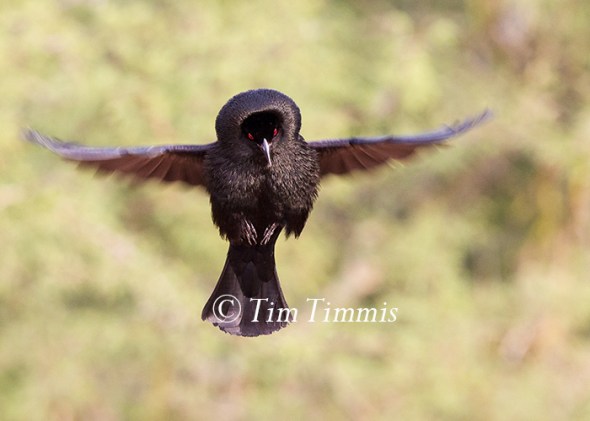
Aperture priority, 1/800 sec @ F5.6, ISO 1600, evaluative metering, 500mm

Pyrrhuloxia
Had to look up the spelling on this bird. Related to the Northern Cardinal, the Pyrrhuloxia thrives in the desert southwest. They were very skittish and didn’t stick around long so I was very pleased to get these shots, especially the wingspan shot of the female.
Took these photos at Santa Clara Ranch in SW Texas in June.
Taken with Canon 1DX and Canon 500mm F4 IS II mounted on a tripod with Wimberley II gimbal head from a photography blind
Aperture priority, 1/1000 sec @ F5.0, ISO 1600, spot metering

Aperture priority, 1/1250 sec @ F6.3, ISO 1600, spot metering

Aperture priority, 1/3200 sec @ F6.3, ISO 3200, evaluative metering

Burrowing Owl Portrait
This juvenile Burrowing Owl was hanging out near the fence line where I was taking photos. Moved my car up close to him and shot away for about 10 min as he was trying to stay awake.
He finally moved for the second photo but there was a blurred out barbed wire fence right above him so I cropped it tighter.
Had to use negative exposure compensation to keep from blowing out the whites on his chest.
Taken with Canon 1DX and Canon 500mm F4 II II with 1.4X III teleconverter, handheld out the car window
Aperture priority, 1/800 sec @ F9, ISO 800, evaluative metering, -2/3 exposure compensation

Aperture priority, 1/640 sec @ F9, ISO 800, evaluative metering, -2/3 exposure compensation

Dive Bombing an Osprey
Had lots of fun taking Osprey photos on my Indiana trip. Their nest was still active with two large chicks along with two protective parents.
The parents had some challenges when flying as several small birds would chase and dive bomb them. It was obvious when the Osprey would take an abrupt turn that they were being chased. Made for some interesting flight shots.
Ended up using all focus points as it was a challenge to keep a single focus point on the fast moving action.
Taken with Canon 1DX and Canon 100-400 II lens, handheld
Aperture priority, 1/1250 sec @ F8, ISO 3200, evaluative metering, + 1 2/3 exposure compensation, 400mm

Aperture priority, 1/1250 sec @ F8, ISO 3200, evaluative metering, + 1 2/3 exposure compensation, 400mm
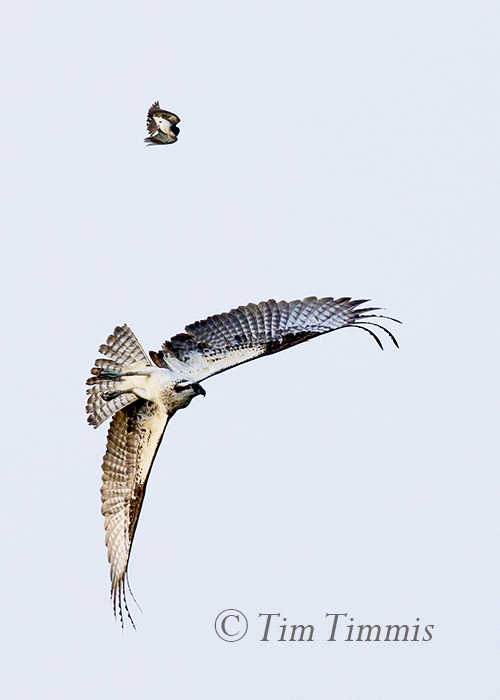
Aperture priority, 1/1250 sec @ F8, ISO 3200, evaluative metering, + 1 2/3 exposure compensation, 400mm

Aperture priority, 1/1600 sec @ F8, ISO 3200, evaluative metering, + 1 1/3 exposure compensation, 400mm

Aperture priority, 1/2500 sec @ F8, ISO 3200, evaluative metering, + 1 2/3 exposure compensation, 400mm

Great Horned Owl
Made my summer trek back home to Indiana a couple of weeks ago with limited expectations from a wildlife photography perspective. We usually go in June when the Osprey’s are nesting and there is an abundance of Sandhill cranes in the area. Therefore, I left my 500mm lens at home and traveled light with my 100-400 II lens.
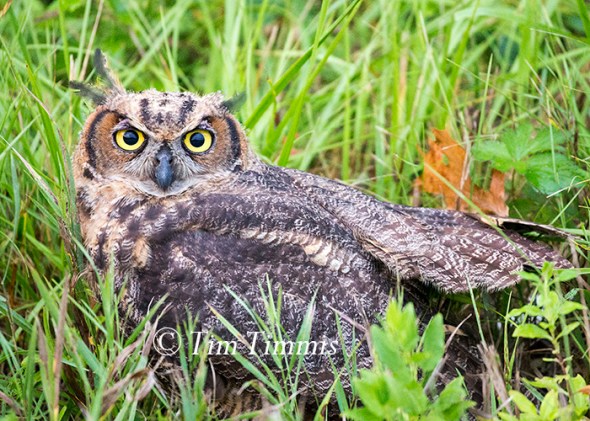
To my surprise, the Osprey’s were still around along with some Sandhill cranes. Best of all, found this Great Horned Owl along a dirt back road.
Just after sunrise, I was driving along my usual route when a bird caught my eye with just a glimpse of something flying just under the tree canopy as it spread over the road going up a hill. I crested the hill and saw the bird gliding very low about one foot above the road. Thought to myself that it wasn’t a hawk but had to be an owl. He flew up into a tree near the road. When my car got closer, he flew away and continued down the road. As he approached an intersection with a paved road, I thought that he was going to get hit by a car if he continued his path but he took a quick right turn before getting to the stop sign.
Drove very slow while scanning the area when I spotted him lying in the grass along the road on my right side. Had to go past him and turn the car around to get into position for some photos. The first photo shows what he looked like after I turned around. Slowly inched the car forward to try to get to a better position with the grass out of his face. Made it to that position but there was some trash just on the left side of his head. Had to move again to get the trash behind his head.
Had to remove my teleconverter and use ISO to 10,000 to get my shutter speed above 100. Luckily he stuck around for 10 minutes which allowed me enough time to remove the teleconverter and get several photos. On my computer, I can see the reflection of my car in his beautiful eyes.
Aperture priority, 1/80 sec @ F8, ISO 12,800, evaluative metering, 560mm

Aperture priority, 1/125 sec @ F5.6, ISO 10,000, evaluative metering, 400mm
Roadrunner Stare-Down
He must have been wondering where the machine gun fire was coming from nearby.
Taken with Canon 1DX and Canon 500mm F4 IS II with Wimberley II gimbal head on a tripod.
Aperture priority, 1/1250 sec @ F8, ISO 3200, evaluative metering, 500mm

Roadrunner Close-up
During my recent trip to Santa Clara Ranch, our goal was to see bobcats that have been frequenting the ponds lately. The ponds in front of the blinds are the only water source on the ranch so they attract lots of wildlife, especially during the hot summer months.
It was looking very promising for us with the previous visitors seeing bobcats at multiple blinds. Our hopes were dashed when it rained on both days. With water available elsewhere on the ranch, the cats didn’t show up. Bummer…
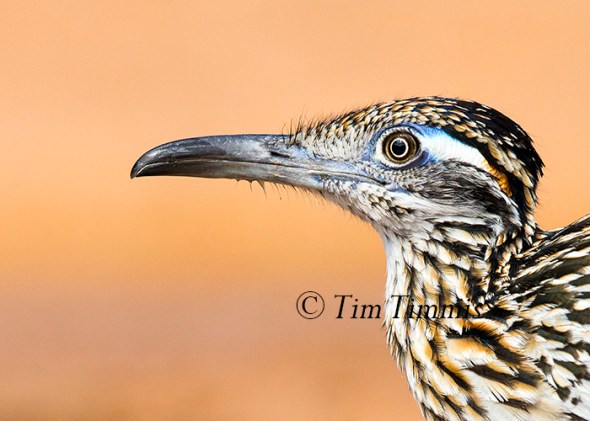
However, we did hit the jackpot on roadrunners. Our guide, Hector Astorga, is an expert at getting roadrunners to come into the blind area. He was calling one with his voice and it tried to come down the stairs into the blind.
This Greater Roadrunner eventually made his way to the pond and started drinking. He was too close for full body shots at the pond so I kept my focus on his eye for head shots. They are beautiful birds that are very colorful and look a little prehistoric, in my opinion.
More photos to follow with direct eye contact and drinking out of the pond.
Taken with Canon 1DX and Canon 500mm F4 IS II mounted on tripod with Wimberley II gimbal head from a sunken blind
Aperture priority, 1/2000 sec @ F9, ISO 3200, evaluative metering, 500mm
Female Painted Bunting at Laguna Seca Ranch
Made another trip to south Texas last week for some photo blind photography. Had a great time as usual. Thanks again Scott for the invitation and Richard for the six-hour ride down south. Spent Friday morning at Laguna Seca Ranch and Saturday/Sunday at Santa Clara Ranch.
It was a little toasty sitting in the blinds with the temps around 98 deg F in the afternoons but it wasn’t as bad as anticipated. Just felt like another warm summer day in the Houston area. Although, I’m not usually sitting in a box at those temp’s, but it was well worth it.
Larry Ditto was our guide at Laguna Seca . It was great to spend some quality time with Larry again as our paths usually only cross briefly at Galveston’s FeatherFest.
The activity was slow on Friday but there were still lots of birds around. We saw some of the usual suspects, including painted buntings, bobwhite quail, green jays, cardinals, bronzed cowbirds, thrashers, etc.
We only saw one of the brightly colored male buntings for a few seconds but there were several female buntings that came up to the water. It’s always fun to shoot off a burst of photos while they are bathing.
Taken with Canon 1DX with Canon 500mm F4 IS II mounted on tripod with Wimberley II gimbal head
Aperture priority, 1/1250 sec @ F5.0, ISO 3200, spot metering, 500mm

Aperture priority, 1/640 sec @ F5.0, ISO 3200, evaluative metering, 500mm

Backlit Jackrabbit
Found this jackrabbit running across a field while taking photos of prairie dogs. He stopped and looked at me for a few seconds and then took off. Thought that he was long gone when he appeared right next me.
The back lighting worked well for his oversized ears.
Taken with Canon 1DX and Canon 500mm F4 IS II with 1.4X III teleconverter, handheld out my car window.
Aperture priority, 1/2000 sec @ F5.6, ISO 1600, evaluative metering, 700mm
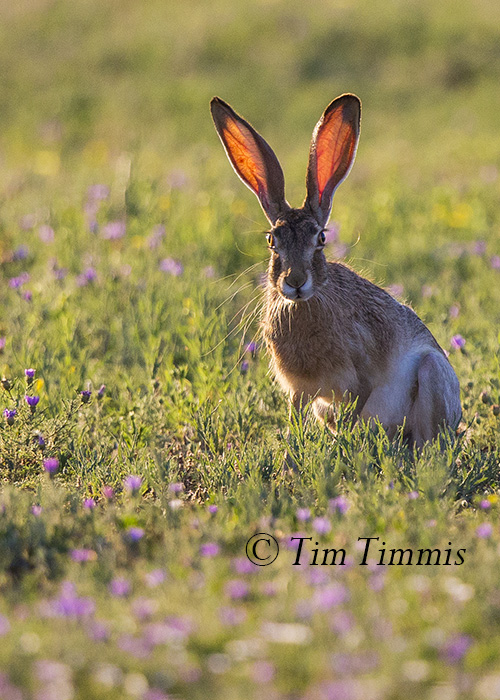
Aperture priority, 1/500 sec @ F7.1, ISO 800, evaluative metering, 700mm

Bobwhite Quail
The call of distant quail seemed to be everywhere on this morning in Lubbock, TX. They move quickly and are very fast runners, which makes it challenging to get photos of them. Did a little stalking and was able to get some photos of these elusive birds.
On the last photo, used the back-focus button to lock focus on the bird and then repositioned my lens to get both rows of barbed wire in the photo with the quail in the left third of the shot, i.e. rule of thirds.
Taken with Canon 1DX and Canon 500mm F4 IS II with 1.4X III teleconverter, handheld out the car window
Aperture priority, 1/800 sec @ F5.6, ISO 3200, evaluative metering, +2/3 exposure compensation, 700mm

Aperture priority, 1/640 sec @ F5.6, ISO 3200, evaluative metering, +2/3 exposure compensation

Aperture priority, 1/500 sec @ F5.6, ISO 1600, evaluative metering, +1 2/3 exposure compensation

Burrowing Owls
During my visit to Lubbock, TX a couple of weeks ago, saw my first burrowing owls while checking out the local prairie dogs. They are very cute little owls with bright yellow eyes that use abandoned prairie dog burrows.
Pulled my car up along a fence line and shot between the rows of barbed wire out the car window. It was lots of fun and I’m looking forward to going back again sometime in the future.
Taken with Canon 1DX and Canon 500mm F4 IS II with 1.4X III teleconverter, handheld out the car window
Aperture priority, 1/800 sec @ F6.3, ISO 1600, evaluative metering, +1/3 exposure compensation

Aperture priority, 1/500 sec @ F5.6, ISO 2000, evaluative metering, +2/3 exposure compensation
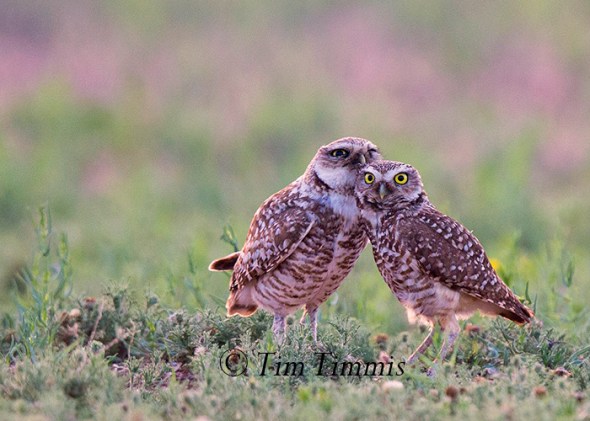
Aperture priority, 1/400 sec @ F5.6, ISO 2000, evaluative metering, +2/3 exposure compensation
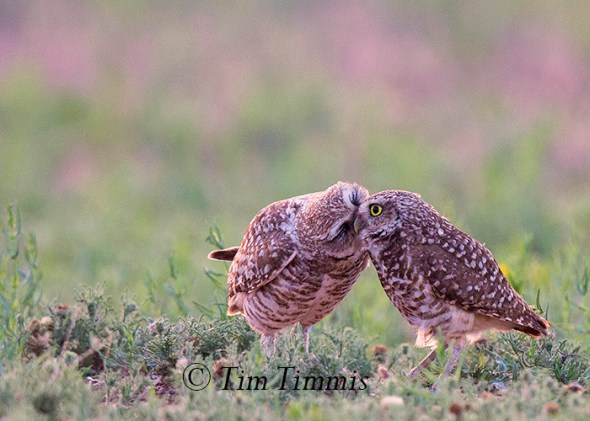
Aperture priority, 1/800 sec @ F6.3, ISO 1600, evaluative metering, +1/3 exposure compensation

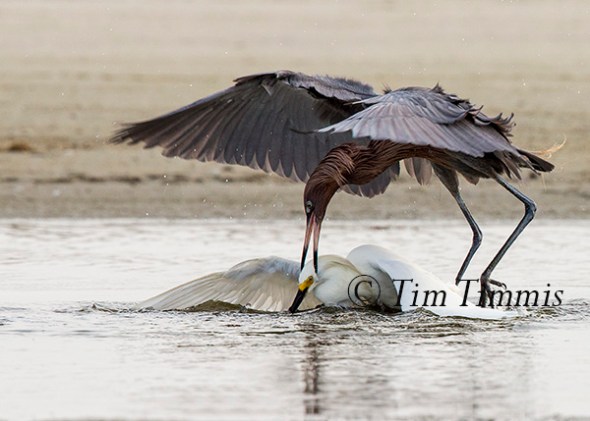
Reddish Egret Attacking Snowy Egret
Reddish Egrets are very territorial and will usually chase off other birds that invade their feeding area. This Snowy egret got more than he bargained for when the Reddish Egret attacked. He quickly dove at the Snowy and grabbed ahold of his tail feathers, swinging him around. He then grabbed the Snow’s head with his beak pinning him in the water. The Snowy ended up escaping and didn’t come back.
Made for some exciting shooting with 37 photos in 3 seconds.
Previewed the last photo at a presentation that I made at the Houston Audubon Nature Photography Association on Wed night, which was also a great time.
Taken with Canon 1DX and Canon 500mm F4 IS II with 1.4X III teleconverter and a beanbag out the car window.
Aperture priority, 1/1000 sec @ F9, ISO 1600, evaluative metering, +1 1/3 exposure compensation

Aperture priority, 1/1000 sec @ F9, ISO 1600, evaluative metering, +1 1/3 exposure compensation

Aperture priority, 1/1000 sec @ F9, ISO 1600, evaluative metering, +1 1/3 exposure compensation

Aperture priority, 1/1000 sec @ F9, ISO 1600, evaluative metering, +1 1/3 exposure compensation

Aperture priority, 1/1000 sec @ F9, ISO 1600, evaluative metering, +1 1/3 exposure compensation
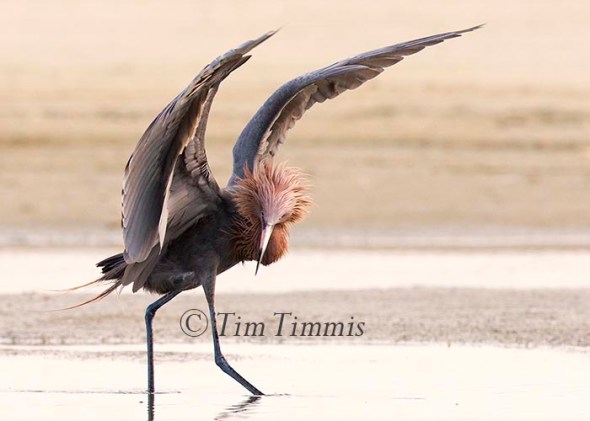
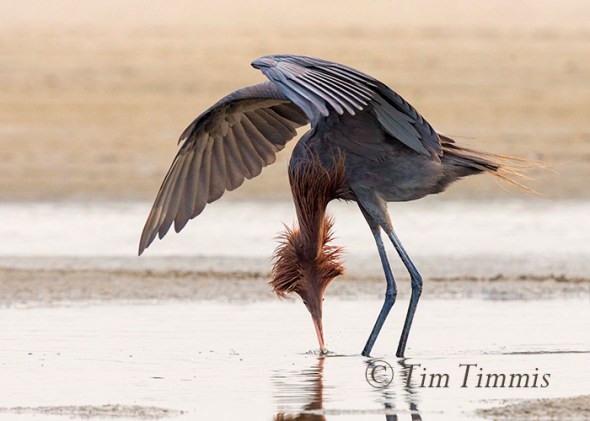
Reddish Egret Jackpot
It’s been a very good year for Reddish Egrets in SE Texas. Hit the jackpot on Saturday morning at the Texas City Dike. My original plan was to head to Bolivar Flats with low tide and almost calm winds. Luckily, I wasn’t feeling Bolivar and decided to head to the Dike instead looking for Oystercatchers. It was a bust for Oystercatchers, which turned out to be a very good thing for me.
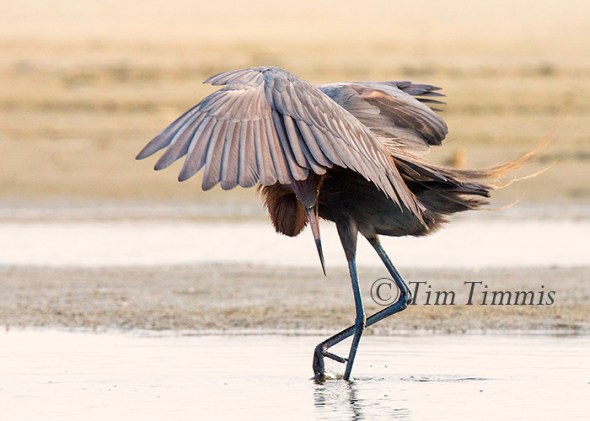
This Reddish Egret more than made up for it while fishing in a tidal pool area. Spent about 45 min taking tons of photos of him out my car window as he moved back and forth catching small fish with his wings outstretched. Had to switch my position once when a family pulled up and unloaded their car near me. Finally left after the action slowed down and my thumb was getting sore from using the rear focus button.
A Snowy Egret also showed up to catch fish in the same area but the Reddish Egret was having none of that and attacked the Snowy. More on that in my next post.
I could tell that this was a good outing by how many photos that I took and ended up saving. In order to reduce how many photos that I have to store, I’ll rate them using Photoshop, by either 3 or 5 stars, and then quickly delete the ones that aren’t rated. I’ll consider processing some of the 5-star rated shots with only a handful actually being processed. A typical outing for me results in 25 to 50 top rated photos. This was a very good day with 334 top rated shots.
Taken with Canon 1DX and Canon 500mm F4 IS II with 1.4X III teleconverter, using a beanbag out the car window.
Aperture priority, 1/1000 sec @ F9, ISO 1600, evaluative metering, +1 1/3 exposure compensation, 700mm
Aperture priority, 1/1250 sec @ F9, ISO 1600, evaluative metering, +1 1/3 exposure compensation, 700mm
Aperture priority, 1/1000 sec @ F9, ISO 1600, evaluative metering, +1 1/3 exposure compensation, 700mm
Reddish Close-up
This Reddish Egret walked around us at FeatherFest during my Ground Level Photography field trip. He was too close for a full bird shot so got these head shots with minor cropping.
Taken with Canon 1DX and Canon 500mm F4 IS II with 1.4X III teleconverter mounted on Skimmer ground pod with Wimberley II gimbal head.
Update: I’ve added copies of the original uncropped photos to show how cropping is a necessity sometimes when there are distracting backgrounds. In this case, we were shooting back towards our cars parked on the beach.
Original photo:
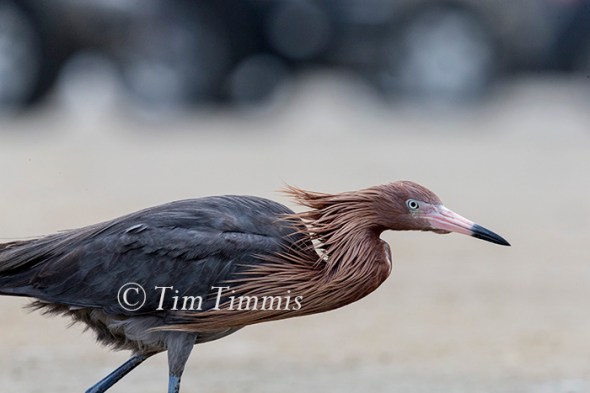
Cropped photo:
Aperture priority, 1/800 sec @ F11, ISO 2500, evaluative metering, +2/3 exposure compensation, 700mm
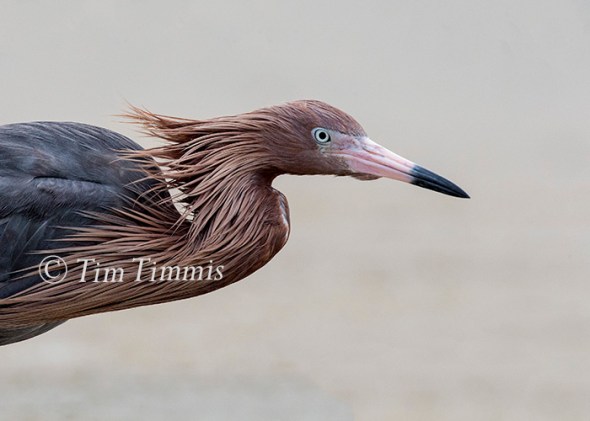
Original photo:
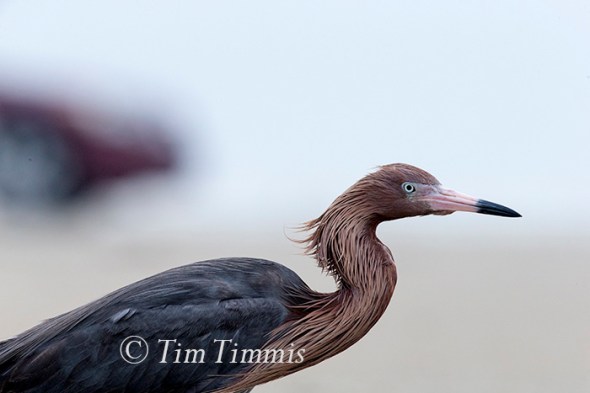
Cropped photo:
Aperture priority, 1/1000 sec @ F11, ISO 2500, evaluative metering, +2/3 exposure compensation, 700mm
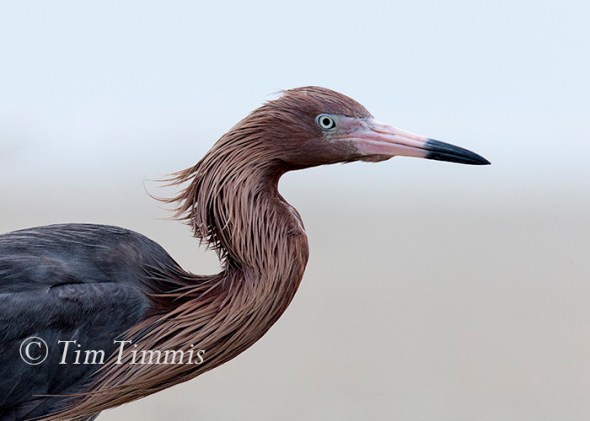
Oystercatcher Action
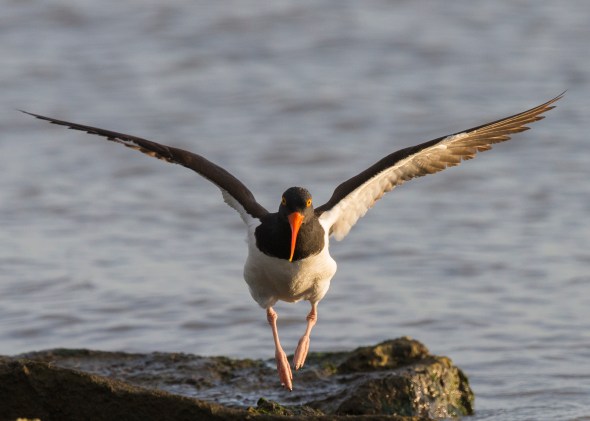
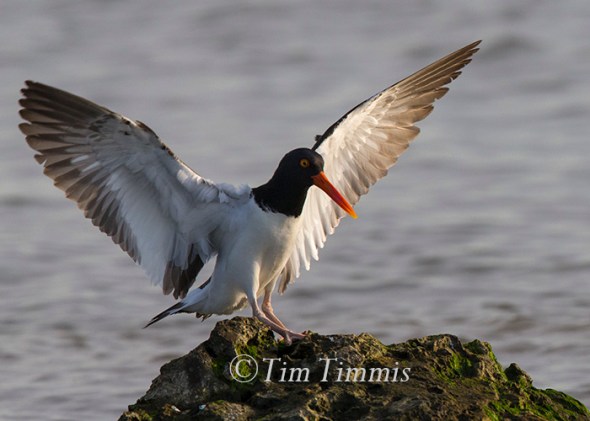
The goal of my trip to the Texas City Dike last weekend was to find Oystercatchers. Didn’t find any in the usual spot so I kept driving down the 5 mile long dike looking along the rocks on the north side. Got a glimpse of something white on a bird and pulled off of the road to check it out. Found 4 Oystercatchers walking along the rocks. They would jump/fly from rock to rock, which provided some nice photo op’s with outstretched wings.
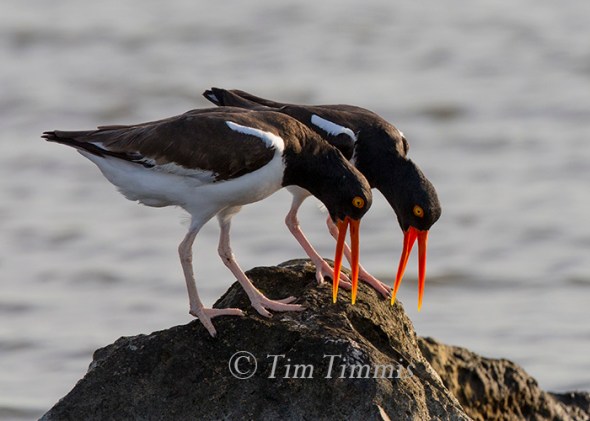
Ended up following them for about 45 minutes until a 5th Oystercatcher flew in. They then displayed “piping” behavior (last photo) for a few minutes and then all five flew off together.
Taken with Canon 1DX and Canon 500mm F4 IS II with 1.4X III teleconverter out the car window using a photography beanbag for support.
Aperture priority, 1/1600 sec @ F9, IS 1600, evaluative metering
Aperture priority, 1/2000 sec @ F10, IS 1600, evaluative metering, +1/3 exposure compensation
Aperture priority, 1/1250 sec @ F10, IS 800, evaluative metering, – 1/3 exposure compensation
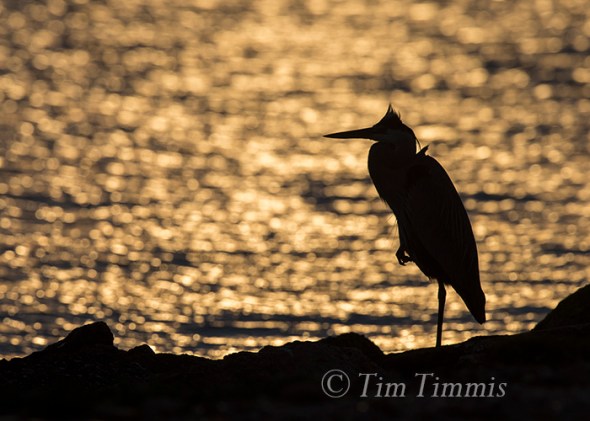
The Making of a Bird Silhouette
Spent last Sunday at sunrise hanging out at the Texas City Dike with tons of birds including Avocets, Black Skimmers, Black Crowned Night Herons and some very cooperative American Oystercatchers. More on the Oystercatchers later.
While trying to find the Oystercatchers, came upon this Great Blue Heron standing on some rocks. Thought that I could turn this into a decent shot but knew that the sun reflecting off of the water behind him was going to be a challenge. From instinct, bumped up the exposure compensation to +1 as the camera’s light meter was going to automatically darken the scene due to the bright background. Checked the histogram and saw that the bird still wasn’t properly exposed per the first photo below. It was going to take a lot more positive exposure compensation to be the Heron looking good, which would have really blown out the background.
Instead, decided to turn this into a silhouette shot. Backed my car up so that the sun reflection was directly behind him. Lowered the ISO to 100, removed all exposure compensation and let the light meter in my camera automatically darken the scene as it was very bright. Was very pleased with the result on the first try. Checked my histogram expecting that a little negative exposure compensation could be needed but it wasn’t. Another silhouette for my portfolio.
Used the back focus button on my camera to set the focus on the bird and then reframed the shot to get him in the right third of the photo.
Taken with Canon 1DX and Canon 500mm F4 IS II with 1.4x III teleconverter, hand-held out the car window using a camera bean bag
Original photo: Aperture priority, 1/3200 sec @ F8, ISO 1600, evaluative metering, +1 exposure compensation
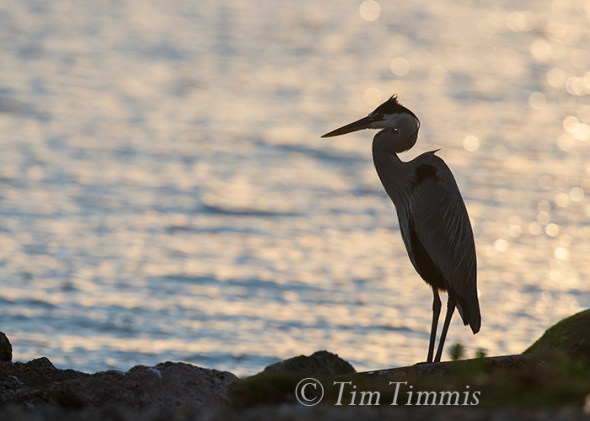
Silhouette photo: Aperture priority, 1/1000 sec @ F10, ISO 100, evaluative metering, no exposure compensation
 Tim Timmis Photography