
Leading Workshops at Galveston’s FeatherFest
Galveston’s FeatherFest is just around the corner, April 11-14. I’ll be leading bird photography workshops again this year along with a couple of field trips. My field trips are booked up but there is still room in the classroom workshops. Look forward to seeing some of you there.
Nest Building Ritual
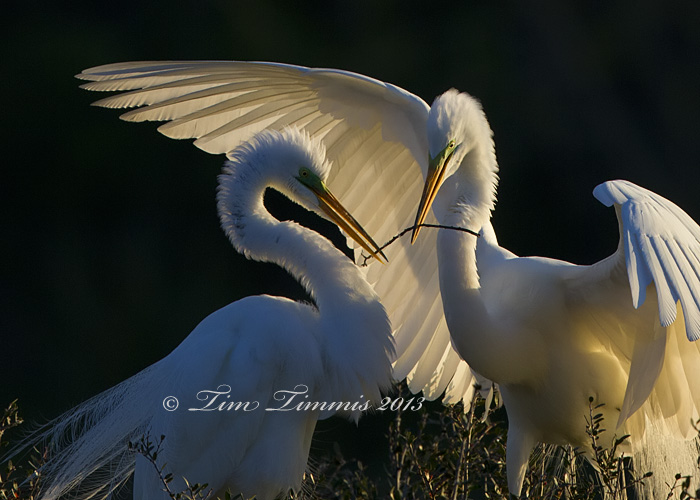
When the mate arrives back at the nest with a stick, the ritual begins with lots of squawking. The stick is then transferred with an abundance of fanfare to the other egret. They often both hang onto to the stick while placing it into the nest. It’s quite the ceremony and interesting to watch and photograph.
I tend to keep my focus on one pair of birds that are in a good position with a decent background. If you get lucky, they repeat the ritual time after time and allow for some great photo op’s. This was one of those times. One of my favorite shots from High Island so far this year.
Using manual exposure and exposing for the brightest spots on the white birds keeps the whites from blowing out, darkens the scene and resulted in the black background.
Taken with Canon 7D and Canon 500mm F4 IS II mounted on tripod with Wimberley II head
1/1250 sec @ F8, ISO 400, manual exposure, 500mm
Backlit and Lovin’ It
I’m a major fan of backlit bird photos, especially from High Island’s rookery. Sunrise is a very special time at the rookery. The sun comes up in your face and provides some great backlit photo op’s. This Great Egret was showing off it’s breeding plumage and backlit wings.
Taken with Canon 7D and Canon 500mm F4 IS II lens mounted on tripod with Wimberly II head
1/1600 sec @ F8, ISO 400, manaul exposure
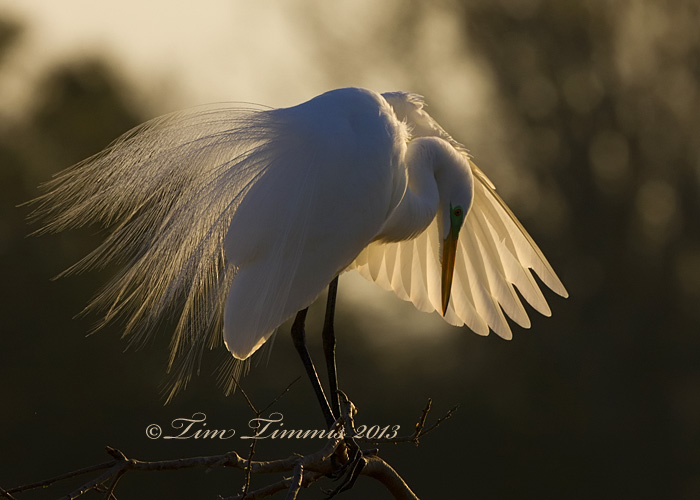
1/1600 sec @ F8, ISO 400, manaul exposure

High Island Nest Building – Part II
Apparently only one stick is not enough to build a nest with, go figure. Therefore, here are a few more sticks in transit. The first photo is the same bird from the previous post as he was coming in for a landing. All taken in manual mode to control the exposure on the white birds. Stick transfer shots are next.
Taken with Canon 7D and Canon 500mm F4 IS II mounted on tripod with Wimberley II head
1/800 sec @ F8, ISO 400, manual exposure
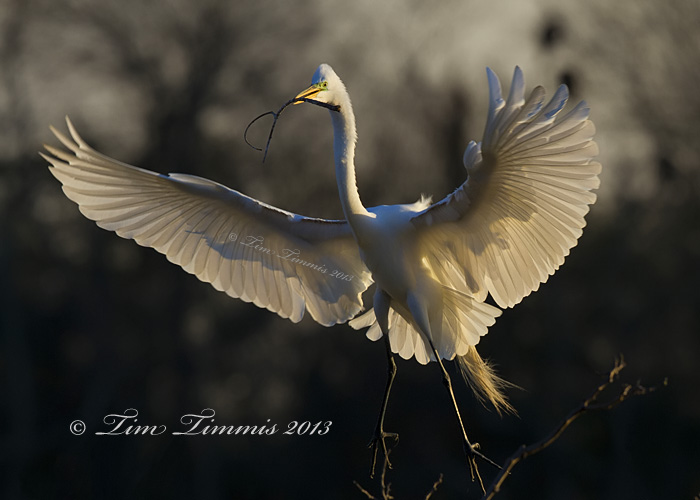
1/1000 sec @ F9, ISO 400, manual exposure

1/1250 sec @ F9, ISO 400, manual exposure
High Island Nest Building – Part 1
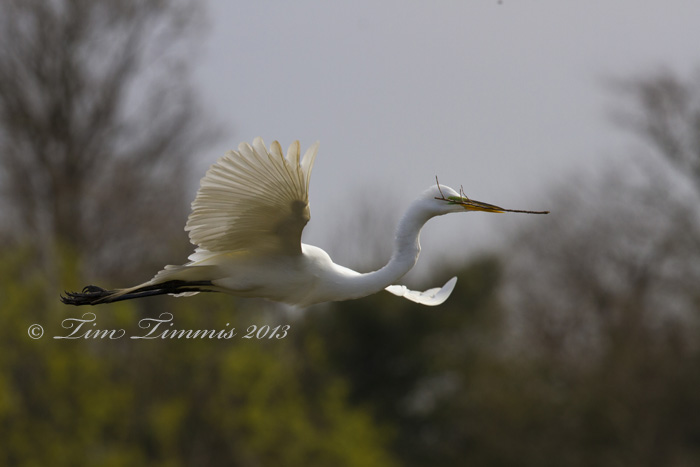
The nesting activity has started early this year at High Island’s rookery. It’ my favorite time when breeding plumage is on display along with the Great Egrets busy mating and building nests. The rookery is filling up quickly with it being difficult to get isolated bird shots.
My keeper rate has gone up this year with my 500mm lens and using manual exposure more. However, 500mm with a crop sensor camera is almost too close in some cases as I’ve clipped lots of wings on action shots.
Caught this Great Egret with wings spread flying back to the nest with a stick. Unfortunately, the mosquitos have almost the same wing span. They are very nasty this year, at least around sunrise, so be prepared.
More to come…
Taken with Canon 7D and Canon 500mm F4 IS II lens mounted on a tripod with Wimberley II gimbal head
1/800 sec @ F8, ISO 400, manual exposure at 500mm

Dripping Avocet
What a difference a day makes. The previous day at Bolivar Flats was cloudy with few birds within reach. The next day was sunny with Avocets right in front of me. My rules of thumb are 1) If you have a bad day photographing wildlife, go back the next day and try again and 2) If you have a great day of shooting wildlife, don’t go back to the same location the next day as you will likely be disappointed as it won’t be the same.
The challenge with Avocets is that they are very skittish, can be difficult to find in a good shooting location and travel in large flocks making it hard to get an isolated bird shot. Found a group of Avocets near a sand bar but didn’t want to get too close and spook them. Found a good shooting location and laid down and waited for them to come to me, which is usually the best strategy. It paid off this time and they made their way towards me. Got several isolated birds and had some being too close at 700mm.
Liked this shot with him looking right at me and the water dripping from his beak. Shot in aperture priority and had to use negative exposure compensation to keep from blowing out the white areas of the bird.
Taken with Canon 7D and Canon 500mm F4 IS II lens with 1.4xIII teleconverter mounted on Skimmer ground pod with Wimberley II head
1/1250 sec @ F9, ISO 400, evaluative metering, -2/3 exposure compensation

Sticky Water
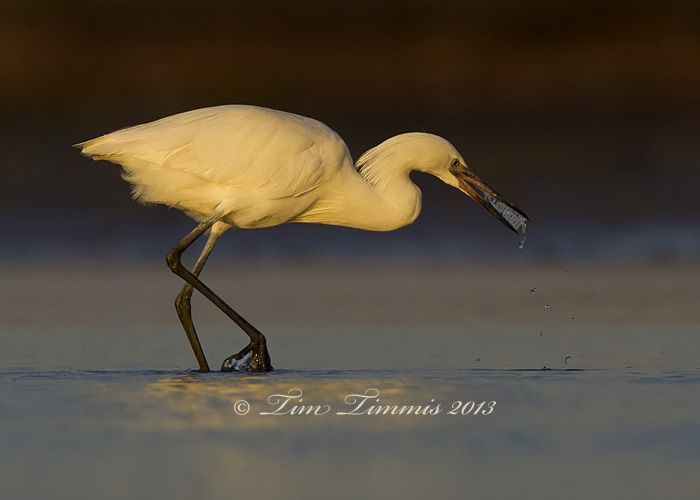
The chemical engineer in me wants to call this “viscous water” but I won’t go there. Caught this White Morph Reddish Egret just at the right time when his beak separated. Haven’t seen this before with and Egret so it made for an interesting shot. Taken just after sunrise in the good ‘ol early morning golden light.
1/1000 sec @ F9, manual exposure, ISO 400, 700mm
Taken with Canon 7D and Canon 500mm F4 IS II with 1.4x III teleconverter mounted on Skimmer ground pod and Wimberley II gimbal head.
Peregrine Falcon
Searched far and wide along the beach for the Peregrine Falcon at Bolivar during this outing with no avail. Had a great day with the Avocets so it wasn’t a total loss. I have learned over the years to keep my camera in the front seat just in case some photo ops present themselves while driving off of the beach. It paid off this time as the Falcon was perched on a fence post on the road to the beach. Slowed down to get a shot and he took off. Turned the car around and following him as he landed on another post. He was on the opposite side of the road from me so I decided to drive fast by him and then turn around. That didn’t spook him and was able to get some photos. Didn’t like the light so I went by him again and turned my car and blocked the road to the beach to get shots from the other side.
Taken with Canon 7D and Canon 500mm F4 IS II with 1.4xIII teleconverter, handheld out the car window.
AV mode, 1/640 sec @ F6.3, ISO 400, evaulative metering, +1 exposure compensation

Willets Part II
Here are a couple more Willet shots from my cloudy outing at Bolivar. The same subject as my previous post but in some different poses. The last one is a full framed shot at 700mm with no cropping.
Taken with Canon 7D and Canon 500mm F4 IS II lens with 1.4x III teleconverter mounted on Skimmer ground pod with Wimberley II head
1/640 sec @ F8, ISO 400, evaluative metering, +1 exposure compensation, 700mm

1/800 sec @ F8, ISO 400, evaluative metering, +1 exposure compensation, 700mm

Willet Portrait
I typically stay home when it’s cloudy but may have to rethink that strategy. Got up last Sat., looked at the radar and saw clouds with some showers in the area. Would have stayed home but was going to meet up Daniel Lim, who introduced me to Bolivar Flats and shooting from the prone position back in 2006. I must have been a slow learner though as I didn’t start shooting this way until 2009.
Couldn’t get close to the Avocets so had to concentrate on the good o’l stand by, the Willet. This is one of my favorite shots. I’ll share a few more later. And yes, I’m still in love with my 500mm lens.
Taken with Canon 7D and Canon 500mm F4 IS II with 1.4x III mounted on Skimmer ground pod with Wimberley II gimbal head.
1/800 sec @ F8, ISO 400, evaluative metering, +1 exposure compensation, 700mm

 Tim Timmis Photography